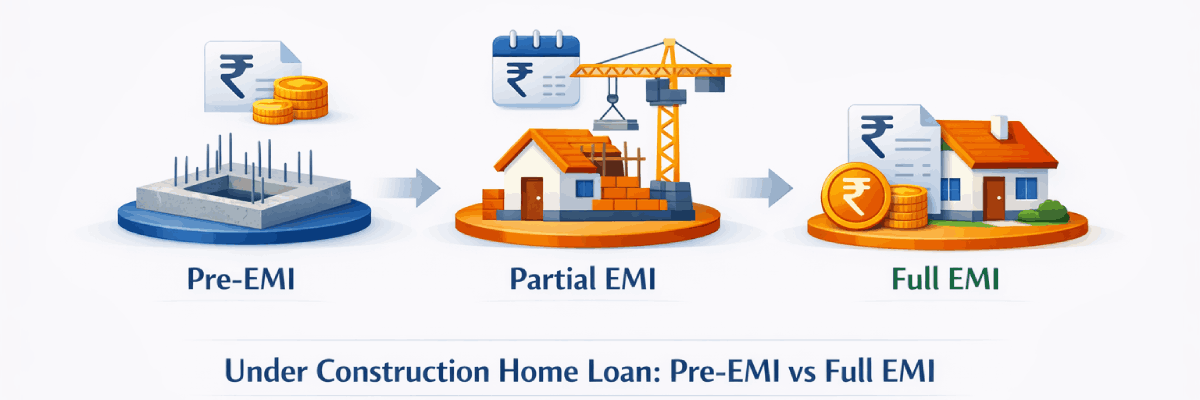
Most home buyers focus on the EMI they'll pay after possession. What they miss — and what can cost them ₹4–5 lakhs extra is the Pre-EMI period: the phase during construction when the bank disburses the loan in stages and charges interest on each tranche released. This interest doesn't go toward reducing your loan. It's an additional cost, on top of your future EMI, that most buyers never calculate before signing.
This guide explains the complete under-construction home loan process with real numbers: how Pre-EMI is calculated at each disbursement stage, what happens when full EMI kicks in after possession, and exactly how to use prepayment strategies to reduce your total interest burden significantly.
👉 Confused about Pre-EMI vs EMI? Calculate your under construction home loan EMI and pre-EMI here.
- Many buyers underestimate pre-EMI and overpay by Rs 4–5 lakh.
- Your EMI can jump sharply after possession.
- A 6–12 month project delay can add lakhs in extra interest.
- Prepayment timing can save years of interest cost.
- Builder payment plan matters as much as your interest rate.
For a ₹50 lakh under-construction home loan disbursed over 24 months, you might pay approximately ₹3–4 lakhs in Pre-EMI interest during construction. Once full EMI starts, your monthly payment jumps from around ₹35,000 (Pre-EMI) to ₹43,000 (full EMI). Understanding this structure helps you plan finances better.
This article covers how under-construction home loan calculators work, Pre-EMI calculation methods, disbursement schedule planning, and prepayment timing strategies. You'll see step-by-step examples showing the difference between construction-linked plans and how to minimize interest costs.
Also use related tools to validate your decision: estimate monthly outflow with our quick EMI calculator, compare prepayment vs investing with our SIP calculator, and check inflation-adjusted affordability before you buy.
Enter your exact loan amount and disbursement schedule below. The calculator shows month-by-month Pre-EMI, total interest during construction, full EMI after possession, and the impact of prepayments.
All calculations, examples, and projections in this article are illustrative and for educational purposes only. Actual interest rates, disbursement schedules, and bank policies vary by lender, property type, and individual circumstances.
Pre-EMI and EMI calculations shown are based on assumed interest rates and disbursement timelines. Always verify terms with your bank and consult with a home loan advisor before making decisions. Tax benefits on home loans are subject to Income Tax Act provisions and individual tax situations.
What is an Under-Construction Home Loan?
When you buy a property that's still being built, banks don't release the entire loan amount immediately. Instead, they disburse funds in stages based on construction progress. This is called a Construction Linked Payment (CLP) plan or under-construction home loan.
How It Differs from Ready Property Loans
| Aspect | Ready Property Loan | Under-Construction Loan |
|---|---|---|
| Disbursement | Full amount at once | Multiple installments over 1–3 years |
| Interest Payment | Full EMI from month 1 | Pre-EMI (interest only) during construction |
| Principal Repayment | Starts immediately | Starts after possession/completion |
| Monthly Outflow | Fixed EMI (₹43,000) | Increasing Pre-EMI, then full EMI |
| Tenure | 20 years from day 1 | 20 years + construction period |
| Tax Benefits | Principal + Interest both | Only interest during construction |
Pre-EMI is the interest you pay each month only on the amount disbursed so far. Unlike regular EMI (which includes principal + interest), Pre-EMI is interest-only. Your principal repayment starts after construction is complete and you receive possession.
Important: EMI (or Pre-EMI) is always calculated only on the disbursed amount, never on the sanctioned loan amount. As each stage-wise release happens, your monthly payment increases based on the new outstanding amount.
How Construction-Linked Disbursement Works
Banks release the loan amount based on construction milestones. The exact stages vary by builder and bank, but here's a typical disbursement schedule for a ₹50 lakh loan:
How does an under-construction home loan work? The lender releases money in milestone-based tranches, not as a lump sum. You pay pre-EMI on the disbursed amount during construction. After possession or final disbursement (as per lender terms), full EMI starts. Total cost depends on timeline, interest rate, and delays.
Standard Disbursement Schedule Example
| Stage | Construction Milestone | % of Loan | Amount Disbursed | Cumulative Disbursed |
|---|---|---|---|---|
| 1 | Booking / Agreement signing | 10% | ₹5,00,000 | ₹5,00,000 |
| 2 | Foundation completion | 15% | ₹7,50,000 | ₹12,50,000 |
| 3 | Plinth level completion | 15% | ₹7,50,000 | ₹20,00,000 |
| 4 | Floor slab completion | 20% | ₹10,00,000 | ₹30,00,000 |
| 5 | Roof/Top slab completion | 20% | ₹10,00,000 | ₹40,00,000 |
| 6 | Completion & Possession | 20% | ₹10,00,000 | ₹50,00,000 |
Timeline: These stages typically span 18–36 months depending on project size. In this example, let's assume disbursements happen every 4 months over 24 months (2 years).
Disbursement schedules vary significantly between banks and builders. Some banks disburse in 4 stages, others in 8–10 stages. Always get the exact disbursement plan in writing from your bank. Delays in construction directly impact your Pre-EMI duration and total interest paid.
Understanding Pre-EMI Calculations
During construction, you don't pay regular EMI. Instead, you pay Pre-EMI, which is only the interest on the amount disbursed so far. Let's calculate this step-by-step using the standard formula for pre-EMI calculation in India.
What is pre-EMI? Pre-EMI is the interest-only amount paid on the portion of loan already disbursed during construction. It does not reduce principal. As more tranches are released, pre-EMI usually rises. This phase continues until possession or full EMI conversion under your loan agreement.
Pre-EMI Calculation Formula
Pre-EMI = (Disbursed Principal × Annual Interest Rate) ÷ 12
Example at Stage 1:
- Disbursed Amount: ₹5,00,000
- Interest Rate: 8.5% p.a.
- Pre-EMI = (₹5,00,000 × 8.5%) ÷ 12 = ₹3,542 per month
After Stage 2 (Cumulative ₹12.5 lakhs):
- Pre-EMI = (₹12,50,000 × 8.5%) ÷ 12 = ₹8,854 per month
Complete Pre-EMI Schedule Example
Here's how your Pre-EMI increases with each disbursement for a ₹50 lakh loan at 8.5% interest, disbursed over 24 months:
| Stage | Disbursement | Outstanding Principal | Monthly Pre-EMI | Months at This Level | Total Pre-EMI Paid |
|---|---|---|---|---|---|
| 1 | ₹5 lakhs | ₹5 lakhs | ₹3,542 | 4 | ₹14,167 |
| 2 | ₹7.5 lakhs | ₹12.5 lakhs | ₹8,854 | 4 | ₹35,417 |
| 3 | ₹7.5 lakhs | ₹20 lakhs | ₹14,167 | 4 | ₹56,667 |
| 4 | ₹10 lakhs | ₹30 lakhs | ₹21,250 | 4 | ₹85,000 |
| 5 | ₹10 lakhs | ₹40 lakhs | ₹28,333 | 4 | ₹1,13,333 |
| 6 | ₹10 lakhs | ₹50 lakhs | ₹35,417 | 4 | ₹1,41,667 |
| Total Pre-EMI Paid During Construction (24 months): | ₹4,46,250 | ||||
Notice that Pre-EMI keeps increasing as more funds are disbursed. In the final months before possession, your Pre-EMI (₹35,417) is close to what your full EMI will be (₹43,391) after possession. This is because you're paying interest on almost the full loan amount, but still not repaying any principal.
Pre-EMI does not reduce principal. If the project is delayed, you may keep paying interest-only amounts for months without shrinking loan balance.
How much extra will you pay if your project is delayed? Model your delay scenario in the calculator
How Pre-EMI Affects Total Home Loan Cost
When Does Full EMI Start?
Full EMI (principal + interest) begins after one of these events, whichever comes first:
When does EMI start? In most under-construction loans, full EMI starts after possession, final disbursement, or a lender-defined trigger in the sanction letter. Until then, borrowers usually pay pre-EMI on disbursed amounts. Always verify the exact trigger in your agreement before signing.
- Possession date: When you receive keys and occupancy certificate
- Final disbursement: When the last installment is released
- Loan agreement clause: Some banks start full EMI 6 months after final disbursement, regardless of possession
EMI After Possession: The Big Jump
Loan Details:
- Loan Amount: ₹50 lakhs
- Interest Rate: 8.5% p.a.
- Tenure: 20 years (240 months)
Your monthly payment increases by approximately ₹8,000 once full EMI starts. This is because you now start repaying principal along with interest. Many homebuyers are caught off-guard by this jump — plan your finances accordingly!
Total Interest Comparison: Ready vs Under-Construction
Because of Pre-EMI and extended timeline, under-construction loans typically cost more in total interest:
| Scenario | Loan Amount | Effective Period | Pre-EMI Paid | Total Interest |
|---|---|---|---|---|
| Ready Property Loan | ₹50 lakhs | 20 years | ₹0 | ₹54.14 lakhs |
| Under-Construction Loan | ₹50 lakhs | 22 years (24 months construction + 20 years) | ₹4.46 lakhs | ₹58.60 lakhs |
| Additional Interest Due to Construction Period: | ₹4.46 lakhs | |||
Under-construction loans are effectively longer than ready property loans. While your EMI tenure is 20 years, you're actually paying interest for 22 years (2 years Pre-EMI + 20 years EMI). This increases your total interest burden.
Under-Construction Home Loan EMI vs Pre-EMI — Key Differences
The good news: you can prepay under-construction loans to significantly reduce interest. The key is when and how much to prepay. Let's explore the best strategies.
Strategy 1: Prepay During Pre-EMI Period
Making lump-sum payments during construction is highly effective because it reduces the principal on which you're paying Pre-EMI, and also reduces the principal for your eventual full EMI.
Scenario: After 12 months (Stage 3), you prepay ₹5 lakhs when outstanding is ₹20 lakhs.
Impact on Pre-EMI:
Long-term savings:
- Pre-EMI savings for remaining 12 months: ₹3,542 × 12 = ₹42,500
- Reduced loan principal for EMI: ₹45 lakhs instead of ₹50 lakhs
- New full EMI: ₹39,052 (instead of ₹43,391)
- Total interest saved over 20 years: ~₹10.4 lakhs
Strategy 2: Prepay Immediately After Final Disbursement
If you receive a bonus or have savings ready, prepay right when full EMI is about to start. This gives you the dual benefit of avoiding one month's Pre-EMI and starting with a lower EMI.
Strategy 3: Regular Small Prepayments During Construction
Instead of one large prepayment, make smaller quarterly prepayments throughout construction:
| Prepayment Schedule | Amount per Payment | Frequency | Total Prepaid | Interest Saved |
|---|---|---|---|---|
| Single lump sum (month 12) | ₹5 lakhs | Once | ₹5 lakhs | ₹10.4 lakhs |
| Quarterly prepayments | ₹1 lakh | Every 6 months (5 times) | ₹5 lakhs | ₹11.2 lakhs |
Regular smaller prepayments during construction tend to save more interest than one large prepayment, because you're reducing the remaining loan amount earlier. However, the difference is marginal. The most important thing is to prepay as early as possible, whether in one go or multiple installments.
When you make a prepayment, banks typically give you two options:
- Reduce Monthly EMI: Keep the same loan tenure (20 years) but lower your monthly payment
- Reduce Tenure (Recommended): Keep the same EMI but finish your loan earlier
Industry recommendation: Choose "Reduce Tenure" as it saves significantly more interest in the long run. Reducing tenure from 20 years to 17 years typically saves ₹2–3 lakhs more than just reducing EMI, even though the monthly relief is less immediate.
Strategy 4: Convert Pre-EMI to Full EMI Voluntarily
Some banks allow you to start paying full EMI (principal + interest) even during construction. This is rarely advertised but can be requested. Important: Even when you opt for Full EMI during construction, the EMI is calculated only on the disbursed amount, not the sanctioned amount. Your EMI will increase as each new tranche is released.
Scenario: ₹50 lakh loan, 8.5% interest, 4 stages over 24 months
- Month 1-6: ₹12.5L disbursed → EMI of ~₹11,000 (on ₹12.5L only)
- Month 7-12: ₹25L total disbursed → EMI increases to ~₹21,500 (on ₹25L)
- Month 13-18: ₹37.5L disbursed → EMI increases to ~₹32,000 (on ₹37.5L)
- Month 19-24: ₹50L disbursed → EMI increases to ~₹43,000 (full amount)
Key point: Switching from Pre-EMI to Full EMI does not reset your loan start date or assume full disbursement. It continues with the tranche-wise logic; you just start paying principal on whatever has been disbursed.
Benefits of Full EMI during construction:
- You start reducing remaining loan amount immediately on disbursed portions
- Total interest burden decreases significantly
- Loan closes faster after possession
Downside: Your monthly outflow is higher during construction compared to Pre-EMI. Only do this if you have stable, high income and can afford the increasing EMI payments as tranches are disbursed.
Tax Benefits on Under-Construction Loans
Tax treatment is different for under-construction loans compared to ready property loans. Here's what you can and cannot claim:
During Construction (Pre-EMI Period)
| Component | Can You Claim Deduction? | Details |
|---|---|---|
| Principal Repayment | No | You're not repaying principal during Pre-EMI period |
| Pre-EMI Interest | Deferred | Can be claimed after possession (see below) |
| Stamp Duty & Registration | Yes | Up to ₹1.5 lakhs under Section 80C (if possession within 5 years) |
After Possession (Full EMI Period)
| Component | Tax Deduction | Maximum Limit | Section |
|---|---|---|---|
| Principal Repayment | Yes | ₹1.5 lakhs/year | 80C |
| Interest on EMI | Yes | ₹2 lakhs/year | 24(b) |
| Additional (First-time buyers) | Yes | ₹1.5 lakhs/year | 80EEA |
| Accumulated Pre-EMI Interest | Yes | ₹2 lakhs/year (spread over 5 years) | 24(b) |
Scenario: You paid ₹4.46 lakhs as Pre-EMI during 24-month construction.
Tax deduction after possession:
- Total Pre-EMI interest: ₹4,46,250
- Can be claimed over 5 equal installments: ₹4,46,250 ÷ 5 = ₹89,250 per year
- First year after possession (assuming normal EMI interest is ₹4.2 lakhs):
Note: Even though your total interest is ₹5.09 lakhs, deduction is capped at ₹2 lakhs per year under Section 24(b). The remaining Pre-EMI portion continues to be claimed over subsequent years.
How to Use Home Loan Calculator for Under-Construction Loans
Most online home loan calculators show EMI for ready properties. To calculate under-construction loan costs accurately, you need a calculator with disbursement scheduling feature. Here's how to use it:
Step-by-Step: Using Fundulator's Under-Construction Calculator
-
Enter basic loan details:
- Loan amount: ₹50,00,000
- Interest rate: 8.5% p.a.
- Tenure: 20 years (240 months)
-
Add disbursement schedule:
- Number of disbursements: 6
- Timeline: Every 4 months over 24 months
- Percentage per stage: 10%, 15%, 15%, 20%, 20%, 20%
-
View results:
- Month-by-month Pre-EMI amounts
- Total Pre-EMI paid during construction
- Full EMI amount after possession
- Total interest payable
-
Simulate prepayments:
- Add prepayment amount and month
- See revised Pre-EMI and interest savings
- Compare scenarios (prepay early vs late)
Use the calculator to model different prepayment strategies. Compare scenarios like "prepay ₹5 lakhs at month 6" vs "prepay ₹1 lakh every 4 months". The calculator will show you which strategy saves more interest based on your actual disbursement schedule.
See How Much Extra Interest YOU Will Pay
Enter your actual loan amount, interest rate, and disbursement plan to get your exact Pre-EMI schedule, total interest over the construction period, and full EMI after possession.
See Your Exact Pre-EMI to EMI Jump →Common Mistakes to Avoid with Under-Construction Loans
Mistake #1: Not Budgeting for Pre-EMI
Many buyers only budget for the final EMI amount and don't account for Pre-EMI during construction. This creates cash flow issues, especially in later construction stages when Pre-EMI is high.
Solution: Calculate your Pre-EMI schedule before booking. Keep funds ready for the increasing monthly payments.
Mistake #2: Not Tracking Disbursement Delays
Construction delays extend your Pre-EMI period. If a 24-month project takes 36 months, you pay an extra 12 months of Pre-EMI, potentially ₹4–5 lakhs additional interest.
Solution: Choose projects from reputable builders with track record of timely delivery. Monitor construction progress regularly.
Mistake #3: Ignoring Prepayment Opportunities
Prepaying during Pre-EMI period has maximum impact, yet many buyers wait until after possession to prepay.
Solution: Prepay as early as possible during construction. Even ₹50,000–1 lakh prepayments every 6 months can save significant interest.
Mistake #4: Not Claiming Pre-EMI Interest Deduction
Many taxpayers forget to claim the accumulated Pre-EMI interest after getting possession, losing out on ₹4–5 lakhs in deductions.
Solution: Maintain records of all Pre-EMI payments. Inform your CA about accumulated Pre-EMI for proper tax planning after possession.
Mistake #5: Not Comparing Construction-Linked vs Subvention Schemes
Some builders offer subvention schemes where they pay Pre-EMI on your behalf during construction. This sounds attractive but often comes with inflated property prices.
Solution: Calculate the effective cost. If property price is ₹5–7% higher under subvention, you might pay more overall even with "free" Pre-EMI.
Should You Buy Ready or Under-Construction?
From a home loan perspective, here's a comparison to help you decide:
Pros:
- Lower total interest
- Tax benefits from day 1
- No construction risk
- Predictable monthly EMI
Cons:
- Higher property prices
- Limited inventory
- Higher immediate cash outflow
Pros:
- Lower property prices (10–30%)
- More choice of units
- Lower initial cash outflow
- Gradual payment schedule
Cons:
- Higher total interest (Pre-EMI)
- Construction delays risk
- Increasing monthly payments
- Deferred tax benefits
Property Value: ₹70 lakhs, Loan: ₹50 lakhs, Rate: 8.5%, 20 years
| Cost Component | Ready Property | Under-Construction |
|---|---|---|
| Property Price | ₹70 lakhs | ₹60 lakhs (15% cheaper) |
| Down Payment (30%) | ₹21 lakhs | ₹18 lakhs |
| Loan Amount | ₹49 lakhs | ₹42 lakhs |
| Pre-EMI Interest | ₹0 | ₹3.75 lakhs |
| Total Interest (20 years) | ₹53 lakhs | ₹49 lakhs |
| Total Cost | ₹1.23 crores | ₹1.11 crores |
| Savings with Under-Construction: | ₹12 lakhs | |
Even after accounting for higher interest due to Pre-EMI, under-construction properties can be significantly cheaper if the property price difference is 15%+. However, this assumes timely delivery with no delays.
Frequently Asked Questions
What happens if construction is delayed?
If construction extends beyond the planned timeline, you continue paying Pre-EMI for additional months. For example, if a 24-month project takes 36 months, you pay 12 extra months of Pre-EMI, potentially ₹4–5 lakhs additional interest. Some banks also charge penalty interest for extended construction periods. Check your loan agreement for specific clauses about construction delays.
Can I prepay during the Pre-EMI period?
Yes, most banks allow prepayment during the Pre-EMI period with no penalties (for floating rate loans). Prepaying during construction is highly beneficial as it reduces both your ongoing Pre-EMI and your future full EMI. Important: Prepayment is applied only to your remaining loan amount (the amount disbursed so far), not the total sanctioned amount. You cannot prepay more than what has been released to you. However, verify prepayment terms with your specific bank — some may have minimum prepayment amounts or processing fees.
How is Pre-EMI different from regular EMI?
Pre-EMI is interest-only payment on disbursed amount during construction. Regular EMI includes both principal repayment and interest. Pre-EMI doesn't reduce your loan principal you're just servicing the interest. Full EMI starts after possession, when you begin repaying principal along with interest, typically resulting in higher monthly payments.
Is Pre-EMI tax deductible?
Pre-EMI interest cannot be claimed as tax deduction during the construction period. However, the total Pre-EMI paid can be claimed in 5 equal installments after you get possession, under Section 24(b), subject to the overall ₹2 lakh annual limit on home loan interest deduction. Maintain proper documentation of all Pre-EMI payments for tax purposes.
- Understand Pre-EMI structure: Pre-EMI is interest-only payment that increases with each disbursement. Budget for escalating Pre-EMI amounts, especially in final construction stages.
- Plan for the EMI jump: Monthly payment increases by ₹7,000–10,000 when full EMI starts after possession. Factor this into your financial planning.
- Prepay during construction: Prepaying during Pre-EMI period has maximum impact on interest savings. Even small prepayments reduce both Pre-EMI and future EMI.
- Track disbursement schedule: Monitor construction progress closely. Delays extend Pre-EMI period and increase total interest paid.
- Calculate total cost properly: Under-construction loans cost ₹4–5 lakhs more in Pre-EMI interest but property prices are typically 10–30% lower, potentially saving you more overall.
- Claim tax benefits correctly: Pre-EMI interest can be claimed over 5 years after possession. Maintain documentation and inform your CA for proper tax planning.
- Use specialized calculators: Standard EMI calculators don't account for disbursement schedules. Use under-construction loan calculators for accurate cost estimates.
Plan Your Home Loan Better
Calculate Pre-EMI, compare prepayment scenarios, and see exact interest breakdowns for your under-construction home loan with Fundulator's comprehensive calculator.
Model Delay Cost in 30 Seconds →Before You Decide: Model Your Scenarios
The difference between a good home loan decision and a costly one often comes down to running the numbers before you sign. Here are four scenarios every under-construction buyer should calculate:
Final Thoughts
Under-construction home loans require more active financial management than ready property loans. The disbursement schedule, increasing Pre-EMI payments, and extended interest timeline all demand careful planning and monitoring.
However, the potential savings from lower property prices often outweigh the additional interest costs. The key is to choose projects from reliable builders, track construction progress, prepay strategically during the construction period, and budget properly for the EMI transition after possession.
Use home loan calculators to model different scenarios before making decisions. Compare the total cost of ready vs under-construction properties in your budget range, factor in construction risk, and choose the option that best fits your financial situation and risk tolerance.
- Get exact disbursement schedule from bank in writing
- Calculate month-by-month Pre-EMI using a specialized calculator
- Budget for the highest Pre-EMI amount (usually final construction months)
- Plan prepayment strategy — set aside bonus/windfall for prepayment during construction
- Track construction milestones and disbursements monthly
- Maintain Pre-EMI payment records for tax deduction after possession
- Review and recalculate if construction gets delayed
Remember: every month of construction delay costs you additional Pre-EMI. Choose your builder wisely, and stay actively involved in monitoring construction progress. With proper planning and execution, under-construction properties can offer substantial savings while building your dream home.