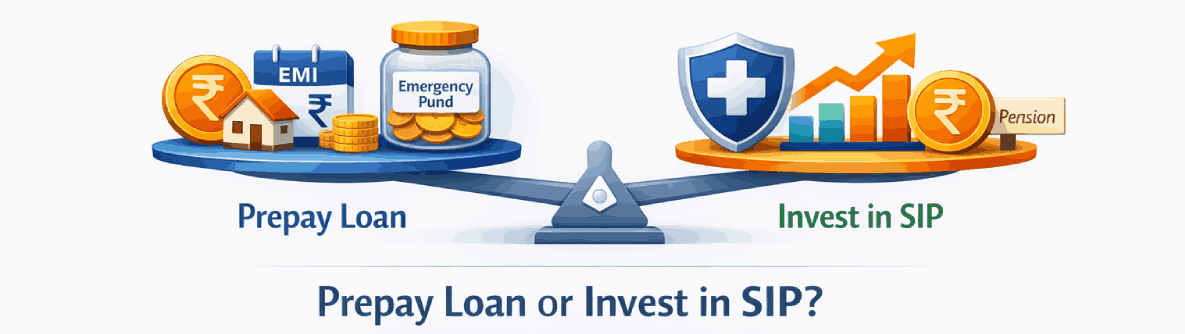
If you are comparing prepay home loan vs SIP India options, this quick framework simplifies the decision. Use it to answer: should I prepay home loan or invest in SIP — based on your own rate, horizon, and risk comfort. The answer is not the same for everyone, and this guide gives you the exact logic to find yours.
All calculations, examples, and tax figures are for educational and illustrative purposes only. Mutual fund returns are market-linked and not guaranteed. Actual returns may vary depending on market cycles. Tax rules are based on provisions applicable as of April 2026. Verify current tax treatment with a chartered accountant before making investment decisions.
TL;DR — Decide in 30 Seconds
Your Personal Decision Calculator
The Only Rule That Matters
Compare your home loan cost against your expected SIP return. Whichever number is higher — that's your answer. Use our home loan EMI calculator and SIP calculator to check your numbers quickly.
Loan 8.5% → ~8.5% effective cost.
Equity SIP at ~12% CAGR (based on long-term historical averages).
Spread: SIP wins by ~2–3% at 12% returns. At 9–10% returns, the gap disappears.
Based on historical market returns. Estimates for illustration. Actual returns may vary depending on market cycles. Review assumptions periodically.
SIP vs Home Loan Prepayment — Quick Comparison
| Factor | Prepayment | SIP Investment |
|---|---|---|
| Return | Guaranteed — equals loan rate | Market-linked — 10–13% historically |
| Risk | Zero. Saving is certain. | Medium — can underperform for 3–5 yrs |
| Liquidity | None — locked in property | High — redeem in 1–3 business days |
| Best for | Loan > 9%, near retirement | Loan < 9%, 10+ year horizon |
| Outcome | EMI-free early, no corpus | Growing wealth, EMI continues longer |
Short-term market volatility (3–5 years) can significantly impact SIP outcomes. Check latest rates before making decisions.
Real ₹ Example — ₹10,000/month Extra
Base scenario: ₹50 lakh loan · 8.5% rate · 20-year tenure. You can replicate this in our SIP calculator using your own monthly amount and horizon.
At historical 12% returns, SIP beats prepayment — but only by ₹5.5 lakhs over 12 years. That's a thin margin for meaningful market risk. Actual returns may vary. Below 10% returns, prepayment wins outright.
Consistency matters more than timing — trying to wait for market dips often leads to missed investing years.
When Each Strategy Wins
- Loan rate is above 9.5%
- Less than 7 years left on loan
- Retirement is within 10 years
- Income is unstable or variable
- Loan rate is below 8.5%
- 15+ years remain on loan
- You can hold through market crashes
- 80C / NPS limits aren't maxed yet
- You need liquidity as a backup
Before prepaying, ensure you've used key tax-saving investments like ELSS and NPS where applicable.
The Smart Strategy: Split It
⚖️ ₹6,000 SIP + ₹4,000 Prepayment
This remains the most balanced approach for most borrowers at 7–9% loan rates. You get ~₹10.5L in interest savings plus a liquid ₹13.9L SIP corpus after 10 years — combined benefit of ₹24L+.
Pure SIP leaves you exposed if markets deliver 6–8% for a stretch. Pure prepayment leaves no liquid corpus. The split hedges both risks and lets you adjust the ratio each year.
🔨 How to Adjust the Split
4 Mistakes That Cost People Lakhs
-
01
Prepaying before emergency fund exists
Prepaying ₹5L then breaking a FD at penalty rate to fund an emergency. Net loss, guaranteed stress.
Keep 6 months of expenses liquid before any extra repayment. -
02
Reducing EMI instead of tenure
When you prepay, banks offer: reduce EMI or reduce tenure. Reducing EMI saves ₹3K/month now. Reducing tenure saves ₹8–10L in total interest.
Always choose "reduce tenure" unless cash flow is critically constrained. -
03
Stopping SIP when markets crash
Redirecting SIP money to prepayment during a 30% correction is the worst possible timing — you miss the best NAV-averaging period.
Automate SIP. If you must cut, cut prepayment — never SIP during corrections. -
04
Prepaying before maxing 80C and NPS
ELSS saves ₹46,800 in tax immediately for a 30% bracket taxpayer — a 31% guaranteed return before the fund even starts. Ignoring this is expensive.
Exhaust ELSS and NPS deductions first. Prepay with what remains.
- Loan > 9.5%: Prepay. The guaranteed saving beats likely SIP returns at current market uncertainty.
- Loan 7–9%: Split ₹6K SIP + ₹4K prepay. Best risk-adjusted outcome for most borrowers.
- Loan < 7%: Prioritise SIP. Let low-cost debt work in your favour over 15+ years.
- Always reduce tenure, not EMI when making any prepayment to the bank.
- 80C and NPS first: Tax deductions give guaranteed returns that beat any prepayment rate.
If You're Unsure — Do This
Default to a 50-50 split and review yearly. Automate ₹5K to SIP and ₹5K as prepayment. As your loan outstanding drops, gradually shift more toward SIP. Consistency beats optimisation.
Still unsure? Compare different scenarios using our SIP calculator and home loan calculator.
Frequently Asked Questions
Ready to Run Your Numbers?
Use Fundulator's free calculators to model exactly how prepayment vs SIP plays out for your loan and income situation.
SIP Calculator → EMI Calculator → SIP Complete Guide →