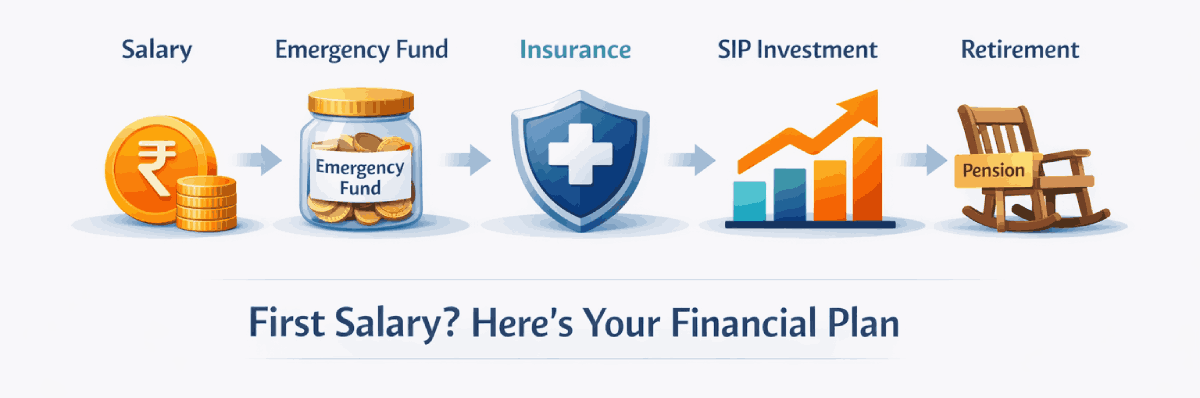
Your first salary is one of the most important financial moments of your life — not because the amount is large, but because the habits you build now will compound for 30 years. This guide tells you exactly what to do, in what order, with real Indian numbers.
If you are researching first salary investment India options, wondering how to manage first salary India decisions, or starting financial planning for freshers India, this guide gives you a practical sequence you can implement from month one.
⚠️ All amounts are illustrative. Insurance premiums vary by age, health, and insurer. Consult a financial advisor for personalised advice.
The most common mistake is treating a first salary as "finally, money to spend." The second most common mistake is the opposite — putting every rupee into a savings account and calling it investing. Neither works.
What works: a clear order of operations. Protect first. Then build. Then grow. This guide gives you exactly that — in the right sequence, with the right amounts.
Emergency Fund + Health Insurance — Set Up Together in Month 1
👉 TL;DR: Start building your emergency fund and get health insurance in the same first month — these two go together. Don't delay insurance while waiting to finish the fund. Without a liquid cushion, every financial plan is one crisis away from unraveling.
An emergency fund is not an investment. It is insurance against your financial plan falling apart. Medical bills, job loss, urgent travel home — any of these can force you to withdraw from long-term investments at the worst possible time. The emergency fund prevents that.
These are not sequential steps — they are parallel. Start allocating to your emergency fund immediately, and buy health insurance in the same month. Waiting to finish the emergency fund before buying insurance leaves you unprotected during the exact period you're most financially vulnerable. A ₹700–800/month health insurance premium is a non-negotiable first expense, not a later consideration.
Where to Keep It
| Option | Return | Liquidity | Recommended? |
|---|---|---|---|
| Savings account | 3–4% | Instant | Keep 1 month here as backup |
| Liquid mutual fund | 6.5–7% | T+1 day | ✅ Best option |
| Short-duration FD | 7–7.5% | Breakable (minor penalty) | Good for stable 6-month block |
| Overnight fund | 6–6.5% | T+1 day | Good for ultra-conservative |
Example: Monthly expenses ₹25,000 (rent + food + travel + bills)
Build this over 3–6 months. Transfer ₹5,000–10,000 per month to a liquid fund until you reach the target. You can start a modest SIP (₹1,000–2,000) simultaneously — the habit of investing matters. Scale up SIP contributions once the fund is built.
FDs can be broken but take 1–3 working days and charge a penalty (0.5–1%). In a medical emergency at midnight, a liquid fund that credits in T+1 is vastly more useful. Keep your emergency fund in a liquid fund, not locked in a 1-year FD.
Health Insurance — Don't Rely on Company Cover
👉 TL;DR: Your company's group insurance is real but it disappears the day you leave the job. Buy your own ₹5–10 lakh policy now, while you're young and premiums are lowest.
Most companies offer ₹3–5 lakh group health insurance as part of CTC. This feels adequate until you realise: it covers you only while employed, it has no portability, and a single hospitalisation can exhaust it. Hospital bills in metro cities routinely exceed ₹3–5 lakhs for serious conditions.
Why Buy at 23 and Not at 30?
- At 23 with no pre-existing conditions: premium for ₹10L cover is typically lower than at 30 — often in the ₹7,000–9,000/year range (approximate; varies by insurer)
- At 30 with minor health issues declared: same cover may cost significantly more and carry waiting periods
- At 35 with conditions like diabetes or hypertension: could face premium loading or exclusions
- Waiting period for pre-existing conditions: 2–4 years — so your health today decides your coverage tomorrow
| Coverage | Who It's For | Approx Annual Premium (22–26)* |
|---|---|---|
| ₹5 lakh | Individual in a tier-2 city, no major risk factors | ₹5,000–7,000/year |
| ₹10 lakh | Metro city resident — recommended baseline | ₹8,000–11,000/year |
| ₹15–20 lakh | Premium hospitals, family history of chronic conditions | ₹12,000–18,000/year |
*All premium figures are approximate and indicative only. Actual premiums vary by insurer, city, sum insured, room rent limits, and individual health profile; policies differ across insurers. Compare quotes on insurance aggregator platforms before buying.
Consider a ₹5 lakh base policy + a ₹20 lakh super top-up (kicks in above ₹5 lakh per claim). This combination can provide substantial coverage at a lower combined premium than a single large policy. Get quotes from multiple insurers — pricing varies meaningfully across providers.
What to Look For
- No room rent sub-limit — "any room" cover prevents shortfall on room charges
- No co-payment clause — you should not pay a percentage of every bill
- Restoration benefit — if your sum insured is used, it should restore for future claims
- No disease-wise sub-limits — cataract or cataract surgery should not be capped at ₹40,000
Term Insurance — Only If Someone Depends on You
👉 TL;DR: If no one depends on your income — skip term insurance for now. If your parents or family depend on you, buy ₹1 crore cover immediately at the lowest possible premium.
Term insurance is pure life cover — no investment component, no returns on premium. ₹700/month buys your family ₹1 crore if you die. That money can replace your income for 15+ years at ₹6,000/month withdrawal. This is insurance, not investment.
The "When NOT to Buy" Nuance
- You have no financial dependents (parents are financially independent, no spouse/children)
- Your family has assets (own house, savings) and won't face financial difficulty without your income
- You are the only earning member but your family lives on their own income
You DO need it immediately if: your parents depend on your salary for rent or bills, you are married, or you have a home loan that could burden your family if you die. In that case: don't delay. Buy at 24 rather than 28 — the premium difference over 30 years is ₹2–3 lakhs.
| Annual Income | Recommended Cover | Monthly Premium (25-year-old, non-smoker) |
|---|---|---|
| ₹6–8 lakhs/year | ₹75 lakhs–1 crore | ₹550–700/month |
| ₹10–15 lakhs/year | ₹1.5–2 crore | ₹900–1,200/month |
| ₹20+ lakhs/year | ₹2.5–3 crore | ₹1,400–1,900/month |
In most cases, it's better to keep insurance and investing separate. Term insurance for life cover, SIP for wealth building. Products like ULIPs and endowment plans mix both functions — and typically do neither particularly well. The insurance cover tends to be inadequate, and the investment returns historically underperform equivalent mutual funds after charges. If you already have one, review the exit costs carefully before deciding to continue or stop.
Budget Structure — The India-Realistic Version
The widely shared "50-30-20 rule" (50% needs, 30% wants, 20% savings) is a starting point from an American personal finance book. It breaks down immediately when rent in Mumbai is ₹22,000 on a ₹40,000 take-home salary. Here's a realistic framework for Indian cities in 2026.
| Category | Metro City (₹50K take-home) | Tier-2 City (₹40K take-home) | Notes |
|---|---|---|---|
| Rent + housing | 35–45% | 25–35% | Non-negotiable. In Mumbai/Bengaluru, 40%+ is common. |
| Food + groceries | 15–20% | 12–15% | Eating out is the biggest leak. Track monthly. |
| Transport | 8–12% | 5–8% | Cab vs metro vs own vehicle — big impact. |
| Insurance premiums | 2–3% | 2–3% | Health + term if needed. Fixed monthly. |
| Savings + investments | 15–20% | 20–25% | Target: 20% minimum. Automate this. |
| Wants / lifestyle | Whatever remains | Whatever remains | Not 30%. Be honest about what you actually want vs need. |
Don't save what's left after spending. Spend what's left after saving. On your salary credit date, immediately transfer your SIP and savings amount. What remains is your spending budget. This one structural change — automation of savings before spending — is worth more than any other budgeting advice you'll ever read.
The Envelope System (India-Adapted)
Maintain three mental (or actual) accounts: Fixed obligations (rent, EMI, insurance — automate) · Variable spending (food, entertainment — set a monthly limit) · Investments (SIP, EPF, emergency build — automate before anything else). If the spending account runs out, it runs out. Don't dip into investments.
Lifestyle inflation is when every salary increase gets quietly absorbed by your spending — a better phone, more eating out, a bigger apartment — leaving your savings rate unchanged. It is the single biggest reason people with rising incomes still feel financially stuck at 35.
The fix is intentional allocation: when you get a raise, decide in advance what percentage goes to investments vs lifestyle. A simple rule: increase your SIP by at least half of every net take-home increment. A ₹5,000 raise → ₹2,500 more to SIP, ₹2,500 for lifestyle. This lets you enjoy income growth without losing compounding momentum. Use our SIP Calculator to estimate your long-term corpus and see how even a ₹1,000 monthly increase compounding over 15 years changes your final corpus.
Where to Invest Your First Salary — India 2026 (Step-by-Step Order)
👉 TL;DR: Salaried? EPF happens automatically — treat it seriously. Start a SIP with even ₹2,000 immediately. If you're in the 20% or 30% tax bracket, add NPS ₹50K/year for the exclusive tax saving. PPF is optional but a strong safe-return layer.
EPF — Your Mandatory Starting Point (and Core Retirement Asset)
If you are employed at a company with 20+ employees, EPF starts automatically from day one. You contribute 12% of your basic salary; your employer matches it. At 8.25% interest (FY 2024-25) compounding tax-free, this remains one of the most reliable guaranteed returns available to Indian salaried employees — with zero effort required.
Think of EPF as your most reliable retirement layer, not just a provident fund you'll access someday. ₹1 lakh in EPF today, left untouched for 25 years at 8%, grows to approximately ₹6.8 lakhs — entirely tax-free if you have 5+ years of continuous service at withdrawal. The compounding is silent, automatic, and irreplaceable.
- Tax hit: Withdrawal before completing 5 years of continuous service is fully taxable as income in that financial year — potentially pushing you into a higher slab and triggering 10% TDS.
- Compounding loss: ₹2 lakh withdrawn at age 26 instead of being transferred can significantly reduce long-term compounding and may cost approximately ₹43 lakhs in foregone corpus by age 58 at 8.25%.
- Employer contribution lost: The employer's share that was building alongside yours stops compounding from the withdrawal date.
The right step at every job change: Transfer your EPF online using your UAN at the EPFO Unified Portal. Takes under 10 minutes. The balance, interest history, and employer contributions all carry over seamlessly.
SIP — Start Small, Start Now
Starting a ₹2,000/month SIP at 24 vs 28 can make a significant difference at 55, based on long-term historical data. The amount matters far less than starting early. A ₹2,000 SIP in a direct-plan Nifty 50 index fund is a better start than waiting to "have more money to invest." Use our SIP Calculator to estimate your long-term corpus and model your own growth projections.
Consistency matters more than timing — trying to wait for market dips often leads to missed investing years.
⚠️ Return disclaimer: The figures below use 12% CAGR, which reflects the long-term historical range for Indian large-cap equity indices. Equity returns are market-linked and not guaranteed. Actual returns may be higher or lower depending on market conditions, fund selection, and holding period.
| Start Age | SIP Amount | At Age 55 (12% CAGR, illustrative) | Difference |
|---|---|---|---|
| 24 years | ₹5,000/month | ₹1.77 crores | — |
| 28 years | ₹5,000/month | ₹1.11 crores | ₹66 lakhs less |
| 28 years (to "catch up") | ₹8,000/month | ₹1.77 crores | Costs ₹3K more every month |
Delaying 4 years forces you to invest 60% more per month to reach the same projected destination at historical rates. Time is the only variable you cannot buy back.
NPS — The Exclusive ₹50K Tax Deduction (For 20%+ Bracket Only)
NPS Tier 1 offers an exclusive Section 80CCD(1B) deduction of ₹50,000 per year — entirely separate from the ₹1.5 lakh 80C limit. No other investment instrument qualifies for this specific deduction.
- 20% tax bracket (₹6–12L taxable income, old regime): ₹50K NPS contribution saves ₹10,400/year in tax. Worthwhile.
- 30% tax bracket (₹12L+ taxable income, old regime): Same ₹50K contribution saves ₹15,600/year. High priority.
- Below 20% bracket or zero tax: The tax saving argument doesn't apply. NPS is still a valid long-term retirement vehicle, but it should not be prioritised over emergency fund, health insurance, or basic SIP at this stage. Consider it once your financial basics are sorted.
- New tax regime: 80CCD(1B) deduction is not available. Ask HR about employer NPS contributions under 80CCD(2), which works in both regimes.
Open NPS Tier 1 at enps.nsdl.com in under 20 minutes via Aadhaar eKYC. Set 65–75% equity allocation (Class E) if you are under 40. Contribute ₹50,000 before March 31st each year to claim the full deduction.
PPF — Optional but Excellent Safe Layer
PPF currently earns 7.1% per annum, compounded annually and fully tax-free. This rate is set by the Government of India and reviewed quarterly — it has been stable at 7.1% since April 2020 but can change. Despite being lower than EPF, PPF carries a genuine advantage: it is available to everyone including the self-employed, has no employer dependency, and is a completely unconditional EEE instrument.
For a 30% tax bracket earner, 7.1% tax-free is equivalent to earning approximately 10.1% on a fully taxable instrument. If you can spare ₹1.5 lakhs per year, opening a PPF account early starts the 15-year clock and gives you access to partial withdrawals from Year 7.
| Instrument | Rate/Return | Tax benefit | Liquidity | Who Should Use |
|---|---|---|---|---|
| EPF | 8.25%† | 80C + tax-free growth | Low (till retirement) | All salaried — automatic. Check your EPF growth using the EPF Calculator. |
| SIP (Equity MF) | 10–13%* | LTCG 12.5% above ₹1.25L | High (T+3 days) | Everyone — start immediately. Use our SIP Calculator to estimate your long-term corpus. |
| NPS Tier 1 | 9–13%* | 80C + exclusive 80CCD(1B) ₹50K | Very low (till 60) | 20%+ tax bracket only. Use the NPS Calculator to estimate your retirement corpus. |
| PPF | 7.1%† | 80C + 100% tax-free | Low (Year 7+ partial) | Risk-averse savers; self-employed; safe layer for all |
* Equity returns are market-linked and not guaranteed. 10–13% represents the long-term historical range for Indian equity indices; actual returns may vary. † EPF rate (FY 2024-25) and PPF rate (current quarter) are subject to periodic revision; check latest rates before investing.
Nominees — The Most Ignored Step That Matters Most
👉 TL;DR: Register a nominee on every account you open: bank, EPF, insurance policy, and PPF. Without a nominee, your family will spend months — sometimes years — navigating legal processes to claim money that belongs to them.
This is the most common gap young earners have. You open a bank account, start a SIP, get an insurance policy — and none of them have a nominee. This is not a theoretical problem. Indian courts and banks handle thousands of unclaimed-account disputes every year because of missing nominee registrations.
Register via net banking or branch. Nominee receives funds instantly without court process. Update after every major life event.
Log in to EPFO Unified Portal (epfindia.gov.in) → Update Nominee section. Without this, your EPF corpus goes through a lengthy claims process.
Set at time of policy purchase. Review annually. If nominee is deceased or wrong, your family won't receive the claim amount promptly.
Set via your AMC portal or broker platform. Without this, folios are frozen and require succession documents to transfer.
A 28-year-old dies in an accident. He had ₹6.5 lakhs in EPF, a ₹1 crore term policy, and ₹3.2 lakhs in mutual funds. None had registered nominees. His family spent 14 months, two lawyers, and ₹80,000 in legal fees to claim what legally belonged to them — while already dealing with grief and income loss.
This is not a horror story. It is routine. Spend 30 minutes tonight on nominee registration.
Real Example: ₹50,000 Take-Home Salary — Complete Monthly Plan
Here's what a complete first-year financial plan looks like for someone earning ₹50,000/month take-home in a tier-1 city, single, no dependents, 24 years old.
Once you've built ₹60,000 in your emergency fund, stop that ₹5,000/month allocation. Redirect it: ₹3,000 more to SIP + ₹2,000 toward PPF deposits. Your investment rate jumps from 28% to 38% without lifestyle change. That's the power of finishing Phase 1 first.
If Salary is Lower (₹25,000–35,000 Take-Home)
| Category | ₹25,000 Take-Home | ₹35,000 Take-Home |
|---|---|---|
| Rent + bills | ₹10,000 | ₹13,000 |
| Food + transport | ₹8,000 | ₹9,000 |
| Health insurance | ₹500 | ₹600 |
| Emergency fund (first 6 months) | ₹2,000 | ₹3,000 |
| SIP (start small) | ₹1,000 | ₹3,000 |
| Remaining for wants | ₹3,500 | ₹6,400 |
At ₹25,000 take-home, even a ₹1,000 SIP is the right move. The habit matters as much as the amount. Increase it by ₹500–1,000 every time you get a raise.
Special Case: Living with Parents — Use This Advantage Aggressively
If you live at home with parents and have minimal rent and food costs, you are in one of the rarest and most powerful positions in personal finance: high savings rate in your early 20s. Don't waste it.
With no rent and shared household expenses, a ₹50,000 take-home salary can realistically see ₹20,000–25,000/month going into investments. At this rate from age 23 to 28 (just 5 years at 12% historical equity returns), you could build approximately ₹18–20 lakhs in your SIP alone — a head start that takes a metro-city peer 10–12 years to match.
Suggested allocation for someone at home: ₹10,000 SIP (equity index fund) · ₹4,200 NPS (if in 20%+ bracket) · ₹6,000 PPF (start the 15-year clock now) · ₹5,000 emergency fund build · Remainder for personal spending. Once emergency fund is complete, redirect those ₹5,000 to SIP or PPF. This window doesn't come back — use it.
Calculate Your Own Numbers
Use Fundulator's free SIP, EPF, and NPS calculators to see how your first-year investments will grow over 20–30 years.
SIP Calculator → EPF Calculator → NPS Calculator →Mistakes That Set You Back 5–10 Years
-
01
Having no insurance at all
The first year of salary often goes without any insurance because "I'm young and healthy." One medical emergency that costs ₹3–4 lakhs wipes out months of careful saving.
Buy health insurance in month 1. It takes 15 minutes online and costs ₹700/month. -
02
Only saving, not investing
₹10,000 sitting in a savings account at 4% for 10 years grows to around ₹14,800. In an equity SIP — assuming historical average returns of around 10–12% CAGR (not guaranteed, market-linked) — the same amount could grow to ₹18,000–21,000. The gap widens dramatically at larger amounts and longer periods.
Open a SIP on the day you open your salary account. Start with ₹2,000 minimum. Amount matters less than the habit. -
03
Random stock picking as first "investment"
The most dangerous moment financially is having income and seeing friends making money in stocks. Research shows 80–90% of individual traders underperform index funds over 3 years.
Start with a direct-plan Nifty 50 index fund SIP. Learn markets for 2 years before picking individual stocks. -
04
Buying ULIPs or endowment plans without understanding the costs
In most cases, products that mix insurance and investment don't serve either goal well. The insurance cover tends to be lower than what a standalone term plan provides, and the investment returns after charges are often below what equivalent mutual funds have historically delivered.
In most cases: term insurance for life cover, SIP for investing. If you already hold one, review the charges and surrender value carefully before acting. -
05
Not increasing SIP with every salary hike
Starting at ₹2,000/month and staying there for 5 years while salary doubles to ₹1 lakh — a classic mistake. Your lifestyle should not absorb 100% of every raise.
When you get a raise, increase SIP by 50% of the net increment. Example: ₹5,000 raise → ₹2,500 more to SIP. -
06
Withdrawing EPF at job change
In most situations, withdrawing EPF when switching jobs is one of the most expensive moves you can make. Before 5 years of continuous service, the entire amount is taxed as income with 10% TDS. Even after 5 years, withdrawing destroys long-term compounding at 8.25% — a guaranteed rate that is hard to replicate elsewhere with zero effort on your part.
Transfer EPF online via UAN at EPFO Unified Portal — under 10 minutes. Treat withdrawal as a last resort, not a default.
- Emergency fund and health insurance go together. Start both in Month 1 — don't treat insurance as something you'll buy after the fund is complete.
- Start SIP immediately — even ₹1,000/month. Starting at 24 vs 28 creates a large corpus gap over time (based on historical equity returns, which are not guaranteed). Use our SIP Calculator to estimate your long-term corpus.
- Automate before you spend. Set SIP and savings transfers one day after salary credit. Spend what remains.
- NPS is valuable — but mainly for 20%+ tax bracket earners. The exclusive 80CCD(1B) deduction saves ₹10,400–15,600/year. If you're below the taxable threshold, focus on emergency fund and SIP first.
- In most cases, keep insurance and investing separate. Term insurance for life cover. SIP for wealth building. Avoid products that promise to do both.
- Register nominees on every account — bank, EPF, MF, insurance. Takes 30 minutes. Protects your family from months of legal complexity.
- Transfer EPF at every job change — in most cases, avoid withdrawing EPF. Withdrawal is taxable before 5 years and can significantly reduce long-term compounding at 8.25%.
- Health insurance costs significantly less at 23 than at 30. Buy it in your first month of employment.
- PPF rate is currently 7.1% — government-set, changes periodically, and fully tax-free. A good safe layer, especially if you start early.
Your Action Checklist — Do This in Your First Month
-
Start your emergency fund AND buy health insurance in Month 1. Open a liquid fund and transfer ₹5,000 toward your target. Simultaneously get a ₹5–10 lakh personal health policy (takes 15 minutes online).
-
Start a SIP of at least ₹2,000/month in a direct-plan Nifty 50 index fund via MF Central, Zerodha Coin, or Groww. Scale it up as your income grows.
-
Log in to EPFO Unified Portal — verify your EPF balance, UAN, and nominee. Update nominee if missing. Treat your EPF as a core retirement asset, not a fund to withdraw at job change.
-
Register nominees on your bank accounts via net banking or branch. Takes 5 minutes online.
-
Open NPS Tier 1 at enps.nsdl.com using Aadhaar eKYC — only if you're in 20% or 30% tax bracket. Contribute ₹50K before March 31 to claim 80CCD(1B) deduction. Skip for now if below the taxable threshold.
-
Buy term insurance only if someone depends on your income (parents, spouse). ₹1 crore cover costs approximately ₹700–900/month at age 25 (varies by insurer). No dependents = this step can wait.
-
Register nominees on your mutual fund folios and demat account via your AMC portal or broker platform.
Frequently Asked Questions
Ready to Go Deeper?
Explore our full guides on SIP investing, EPF/PPF/NPS retirement planning, and home loan calculators — all free, all India-specific.
SIP Guide → NPS vs PPF vs EPF → SIP Calculator →